
Linden Sources for Previous Residents by Era
Previous residents of a Linden property appear in different records at different times. The strongest backward trail starts with today’s parcel identifiers, reaches the latest deed, and then follows the legal parties into older instruments. Directories, census schedules, maps, newspapers, permits, and probate material add context, but they should not be treated as interchangeable proof. The County Clerk describes a land-record room reaching back to 1857, whereas the online land index is a modern access layer with image and coverage limits. An online no-result is therefore not a final answer for an older Linden address.
| Source | Years It Covers | Where Held | What It Shows |
|---|---|---|---|
| Union County Clerk land record room | 1857 forward | Union County Clerk, Elizabeth | Recorded land transactions and older deed routes |
| UCPA land index | Modern published window; online history begins June 1, 1977 | Union County Clerk online portal | Party, date, document, book/page, instrument, and published images |
| Linden city directories | 1929-1982, 23 listed years | DigiFind-It and Linden library route | Dated name and address snapshots, subject to year gaps |
| Federal census releases | 1900, 1910, 1920, 1930, 1940, and 1950 relevant | Federal historical census sources | Household, age, relationship, birthplace, occupation, and address context |
| Sanborn map context | 1923 Linden sheets in an Elizabeth volume | Library of Congress | Buildings, streets, and industrial or fire-insurance context |
For a post-1977 question, start with the portal and confirm the current parcel data. For an earlier question, expect to branch to the Clerk’s record room, the library, a map collection, or the New Jersey State Archives. A property transfer can explain ownership, while the past residents of the address need a separately dated household source.
Linden Previous Residents Address Clues
Begin with the street address exactly as it appears in the document or family record. Use Linden’s official maps to orient the street, grid, ward, and tax-map context. Then use the NJGIN parcel program, New Jersey YourMoney property data, or the City’s SDL Portal for the block, lot, assessment-year, owner, permit, or property details that are publicly available. SDL describes searches by address, owner name, or permit number, while YourMoney is a January data snapshot and NJGIN warns that parcel boundaries are not legal survey boundaries.
Write down three identifiers before switching systems: the original street line, the block and lot, and the deed’s instrument or book and page. A situs address is the physical parcel. A mailing address is where the record owner receives notices. A legal description is the property language in a deed. Those terms cannot be silently substituted for one another, and an owner field does not show who occupied a Linden address.
Address-first tip. A Linden address is not the primary key in the County Clerk land index. Convert the parcel result to the current owner or legal party, then search that party and the reverse party to move backward.
Linden Previous Residents Deed Chain
The Union County Clerk land records portal is the recorded-instrument route for a Linden property. The name search accepts a required last name, optional first name, exact, starts-with, or Soundex matching, required from and to dates, a party-type choice, document type, and results-per-page controls. Search the current owner or grantee first, inspect the reverse party, and save each recorded date, document type, book/page or instrument number, and image status. Search both grantor and grantee roles, because a trust, estate, corporation, or representative may be the indexed party rather than an everyday name.
- Use the current parcel route to capture block, lot, owner field if displayed, and the latest deed reference. Do not treat an assessment value or permit applicant as a deed party.
- Find the most recent purchase or transfer in the Clerk index. Copy the recorded date, document type, indexed party, reverse party, book/page or instrument number, and the source URL.
- Search the seller from that deed as a grantee to find the prior acquisition. Repeat this reversal, keeping each row in date order.
- Use exact, starts-with, and Soundex searches for spelling variations, initials, entity suffixes, and representative roles. Check the image or official index row before entering a party in the chain.
- When the online index or image trail ends, ask the Clerk record room or certified-copy route for the bounded name and date range. Retain the older legal description rather than forcing a modern street number.
- Grantor and grantee
- The grantor transfers an interest; the grantee receives it. Their names identify legal roles in a document, not necessarily residents.
- Chain of title
- A date-ordered series of transfers for the same parcel, supported by instruments or book and page references.
- Legal description
- The deed’s formal property description, often a lot, block, subdivision, or metes-and-bounds reference. It can survive an address change.
Note: A deed chain documents transfers and parties, not continuous occupancy between each recorded event.
Linden Previous Residents Deed Index
The Clerk portal offers different routes for a different fact. The name index is best for grantor and grantee work. The date index requires a document type and a from/to range limited to 31 days. The book/page screen requires document type, book, and page, while the instrument search uses document type, year, prefix, instrument number, and suffix. If a prior document already supplies a book and page, that route can be more precise than re-running a broad name search.
Use the Union County Clerk book and page search when an older chain row has those references. The capture shows the document type, book, and page controls used to retrieve a bounded instrument.
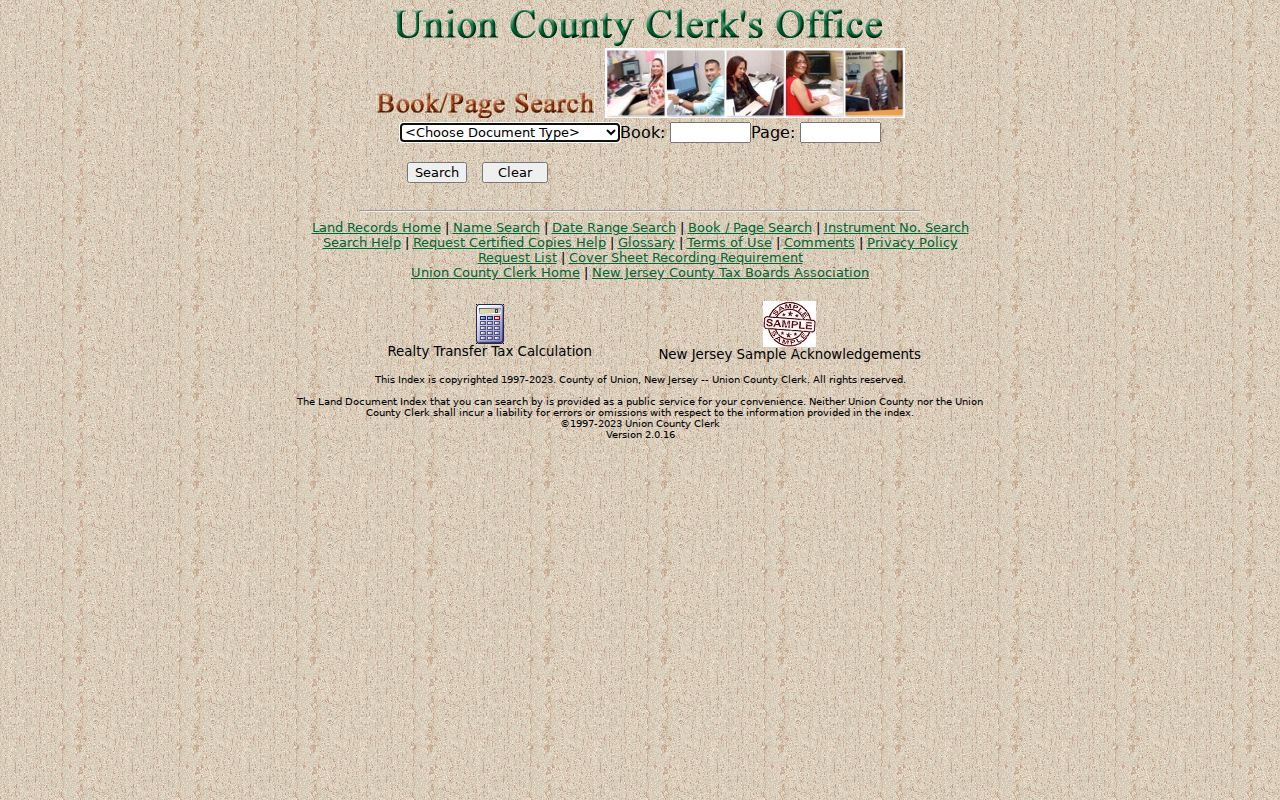
That lookup is one part of the Linden address trail. Published documents may offer an image, and certified-copy requests have online credit-card and mail routes through the Clerk system. Older or image-limited material may require the Clerk’s office at 2 Broad Street in Elizabeth, where the recording window is listed as Monday through Friday, 8:30 a.m. to 4:30 p.m.; over-the-counter recording is generally until 3:30 p.m. Call 908-527-4787 before a records visit.
Linden Previous Residents and Older Maps
An older street line may need map context before it can be compared with a deed or directory. Linden’s official map includes an A-R and 1-28 grid, street-name index, municipal lines, rail corridors, waterways, parks, cemeteries, and city locations. These are orientation tools, not parcel boundaries or proof of ownership. Preserve the old spelling and number first, then compare it with City tax maps, parcel layers, and the deed’s legal description.
The Library of Congress 1923 Sanborn item includes Linden as a secondary location in the Elizabeth volume. It has 70 sheets and can show building footprint, street or corridor history, industrial context, and fire-insurance map detail. It cannot identify every resident. For a Linden property near the waterfront or a historic industrial area, pair the map with a recorded instrument, permit or certificate request, and the newspaper title active in the target year.
Linden Past Residents in Directories and Census
Legal owners are only one layer of a house history. To learn who lived here before, compare the recorded transfer with the closest Linden directory year, the surrounding federal census, and a relevant newspaper notice. The online Linden directories list 23 years between 1929 and 1982 with substantial gaps, so a missing listing is not a finding by itself. Review the scan visually, save its page and column context, and record whether the volume is alphabetical, street ordered, or contains a reverse section.
The historical collections themselves are maintained through the Linden city directories route. The useful household sequence is simple: dated directory entry, census household, dated newspaper or obituary, then a vital or probate record only when its access rule permits. Census releases can distinguish similar names through age, relationship, birthplace, occupation, and address, but they do not create an annual record of residence. An obituary or probate file can explain a transfer or departure, while neither substitutes for the recorded deed.
- Choose the directory item nearest the transfer or event date and capture the year, title, page or image, and exact line.
- Pair it with the nearest available census release, comparing household relationship, age, birthplace, and address rather than a name alone.
- Search the matching Linden newspaper title for a public event, death notice, estate sale, business mention, or address reference.
- Mark each source as owner, occupant, household member, business, or historical mention. Stop when the remaining link would require an inference.
Lawful use. Linden house-history research is for family history, estate context, and civic curiosity. Do not use dated records to track, threaten, intimidate, repeatedly contact, or harm a living person; New Jersey’s harassment and stalking framework includes N.J.S.A. 2C:12-10.
Linden Previous Residents Are Record Snapshots
A common mistake is to treat a deed, voter entry, directory listing, or custody result as proof of current residence. Each is a record snapshot with a different date and purpose. A parcel can be owned by an entity, an estate, or a person who lived elsewhere. A property may be vacant, used by a business, or occupied by someone unrelated to the legal owner. Daniel’s Law can also redact covered names or addresses in government and parcel products, so an empty field may reflect a lawful privacy limit rather than a gap to overcome.
Use a dated source log with the original street text, block/lot, party role, record type, date, page or image, URL, and a short confidence note. The County’s property-fraud alert can notify an enrolled name when a recording appears, but it is early warning, not title proof or a way to establish who lived at a Linden address. Note: Records that disagree should remain separate until an official document or historical source resolves the conflict.
Linden Address-History Help and Requests
When the web record stops, use the custodian that holds the next source. Linden Public Library can help identify directories, newspapers, microfilm, yearbooks, and local-history leads. The Union County Historical Society is a county archive inquiry route for manuscripts, books, records, and documents; ask whether a named collection has an index, original material, microfilm, or a finding aid. The New Jersey State Archives is the state route for historical land, county, vital, naturalization, and manuscript research under its appointment and copy rules.
The Union County Historical Society image shows a local archive contact point for a bounded Linden historical question.

An archive inquiry works best with the address or block and lot, the date range, a named record series, and the question being tested. For a defined City record, such as an older assessment card, permit, certificate, map, or related municipal file, use the Linden OPRA request form with a bounded date range and department. New Jersey OPRA permits written, mailed, hand-delivered, or electronic requests to the proper custodian, subject to exemptions and privacy review.