
Linden City Directory Collections by Access
Linden’s best verified directory starting point is the DigiFind-It directory collection. It describes the run as 1929 through 1982, while the item list identifies only 23 separate years. That distinction matters. A listed range describes the shelf, not uninterrupted publication or surviving scans. Linden Public Library combines that online collection with local newspapers, microfilm, yearbooks, and reference help. For material beyond the local digital shelf, the Union County Historical Society and New Jersey archival collections are useful inquiry routes, though neither was verified as a complete online name catalog for Linden.
| Collection | Years | Where Held | Access |
|---|---|---|---|
| Linden digitized city directories | 1929-1982, 23 listed years | DigiFind-It Linden archive | Online scans; inspect each image |
| Linden local newspaper runs | 1920-2025 across changing titles | DigiFind-It and Linden Public Library | Online issues and library microfilm |
| Linden yearbooks | 1932-2015 | DigiFind-It / library research route | Check access and privacy conditions |
| Linden history finding-aid leads | 1863-67 ledger and chiefly twentieth-century material | Library and State Library finding aid | Confirm holding and reproduction rules |
| Union County historical material | Varies by collection | Union County Historical Society | Archive inquiry; online catalog is incomplete |
Use the collection page as provenance even when a direct PDF pattern is available. The archive reports a keyword form with match-any or match-all choices, yet some scans may be image-based and their OCR can vary. A returned keyword is a lead, not proof. Read the page, note the year and filename, then record whether the page is alphabetical, street ordered, or part of another index.
Linden Directory Years Are Not Continuous
The verified online list contains 1929, 1930, 1931, 1933, 1935, 1937, 1939, 1941, 1945, 1947, 1949, 1951, 1953, 1955, 1957, 1959, 1961, 1963, 1965, 1967, 1969, 1981, and 1982. It does not list 1932, 1934, 1942, or the 1970 through 1980 span, among other gaps. A missing item can reflect a gap in the online collection, not a conclusion that a household left Linden. Check nearby directory years, newspaper titles for the period, and the library’s physical holdings before treating an absence as meaningful.
View the Linden DigiFind-It directory list before choosing a year. The image shows the collection controls and the individual year entries that need to be checked one by one.
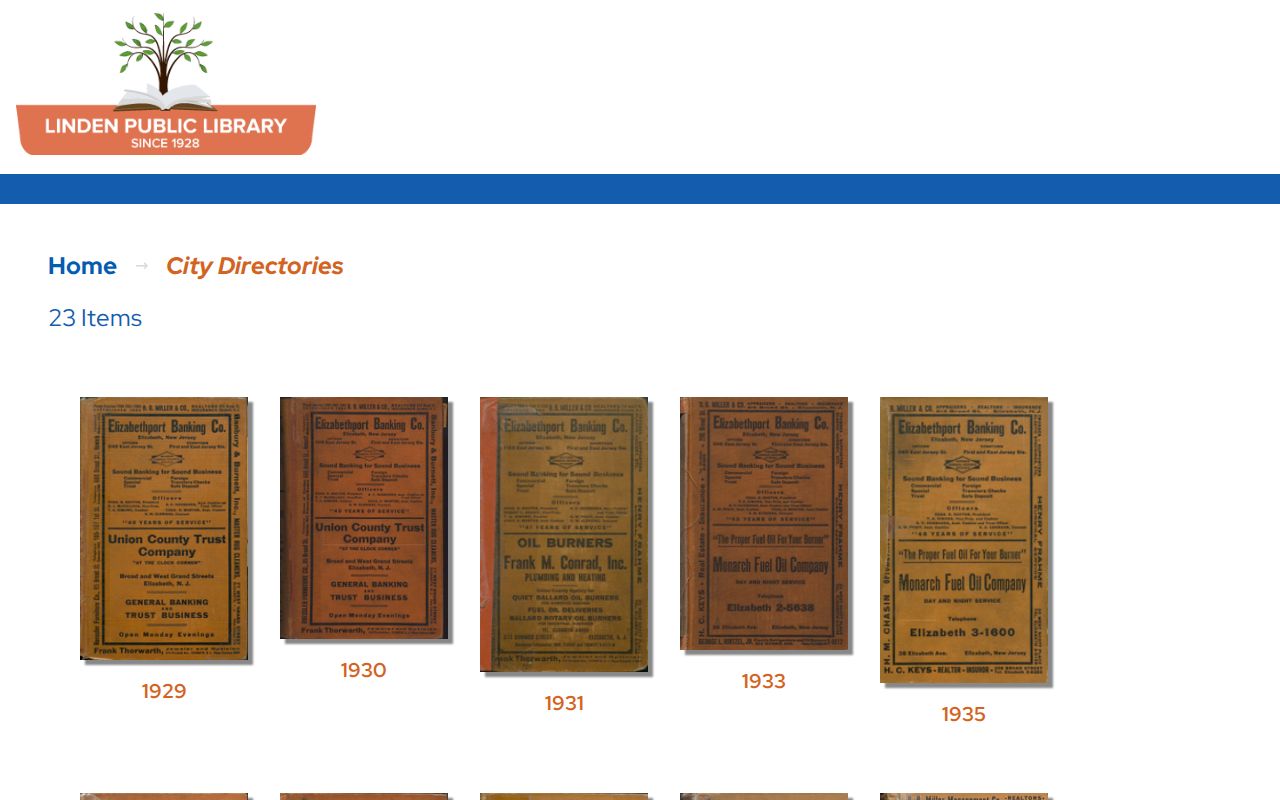
Those discrete entries are why a sound Linden city directory search leaves room for missing years and marks each inspected volume in a source log.
| 1857 | Union County formed; County Clerk land records are described as available in the record room from that year forward. |
|---|---|
| 1861 | Linden township was created, so earlier records may use Elizabeth, Rahway, or another parent jurisdiction. |
| 1925 | Linden became a city, a useful jurisdiction marker when comparing later directories and civic records. |
| 1929 | First year in the verified digitized Linden directory list. |
| 1982 | Last year in that verified online directory list, not necessarily the last paper directory ever printed. |
Note: A collection gap is a finding to document, not evidence that a person or address disappeared from Linden.
Linden Library Routes Beyond the Scans
Linden Public Library, at 31 East Henry Street, is the practical in-person starting point for local history questions. Published hours are Monday through Wednesday 9 to 9, Thursday 9 to 5, Friday 9:30 to 5, Saturday 9 to 5, and Sunday closed; holiday and seasonal changes should be confirmed before a visit. The library’s periodicals holdings include Linden Leader and Linden News microfilm from November 1927 through June 1955, Linden News Observer from June 1955 through January 9, 1964, and several Linden Observer runs. Library copy or print pricing was listed at $0.15 per page for library materials.
The periodicals page and the library’s digital-resources links help separate a digitized directory from a newspaper or microfilm trail. Ask for a collection title and call number, whether a reverse or criss-cross volume exists for the target year, the relevant newspaper title, and the current reproduction policy. Reference staff can also clarify whether a finding-aid item, such as the WPA history, WWII residents’ photo album/card file, or chancery-sales ledger, is available for consultation.
- Bring the exact name spelling, alternate initials, address, and the year being tested.
- Ask whether the requested year is a scan, microfilm issue, paper volume, or a finding-aid lead.
- Record the title, year, page or image number, and the date the item was consulted.
- Keep a newspaper title change in the notes, since the Linden runs use several names over time.
How to Read a Linden City Directory Entry
A Linden city directory entry must be read from the actual volume, not reconstructed from standard directory habits. Research did not verify a legible 1929 line-level example, and it did not establish a named publisher for every Linden year. City directories commonly organize names by surname and may include an address, telephone, occupation or business, and spouse or household markers. Whether any one Linden volume prints those fields, uses a reverse section, or supplies owner or renter marks must be checked on its title page, key, and page layout.
| Name as printed | Copy the full spelling, initials, suffix, and punctuation. Similar names should remain separate until another dated source supports a match. |
|---|---|
| Address or street line | Preserve the historical form before normalizing North, South, Street, apartment, or hyphen differences. |
| Occupation or business text | Log it as a dated description, not a claim about a person’s current role or address. |
| Household marker | Record any parenthetical or spouse-style notation exactly and compare it with a census or vital record only when access permits. |
| Page context | Save the directory year, title, page or image, column, and alphabetical or address arrangement. |
- Criss-cross directory
- A reverse arrangement that may organize listings by street and number rather than by surname. Its presence in a Linden volume must be confirmed from that scan.
- Householder index
- An index focused on the named household contact or head of household. It is not the same as a complete list of every occupant.
- Abbreviation key
- The volume’s own list of shortened terms. Photograph or transcribe it before expanding an unfamiliar mark.
Note: An historical listing can identify a dated appearance, but it does not establish a person’s present residence.
Linden Directories Need Newspaper Context
Directories become more useful when a Linden newspaper or archive source adds a dated event. DigiFind-It joins several title runs: Linden Observer, News-Observer, New Linden Leader, Linden Leader, Spectator Leader, The Progress, and Union County Local Source. Search the title that matches the target year rather than assuming one continuous Linden newspaper. A notice can help distinguish people with the same name, but a common surname still needs an address, age, household relationship, business description, or another matching detail.
The Union County Historical Society collects Union County books, records, documents, manuscripts, and related material at the Dr. Carl Hanson House in Cranford. Its mission makes it a useful route for a narrow county-history inquiry, not a substitute for a confirmed Linden directory catalog.

When a Linden directory, newspaper, or map trail stops, an archive inquiry can ask whether a named Union County collection has an index, original material, microfilm, or only a finding aid.
Linden Directory Names Follow City History
Linden’s civic timeline helps explain a puzzling place name in an older record. The township began in 1861 from Elizabeth and Rahway-area territory, and Linden was incorporated as a city on January 1, 1925. A directory, census, newspaper, deed, or archive reference from before city status may use Elizabeth, Rahway, another parent jurisdiction, or Union County rather than the modern city name. Search those jurisdiction variants while preserving the wording on the original page.
Historical address work can also use the 1923 Library of Congress Sanborn item, where Linden appears as a secondary location in the Elizabeth volume. Its 70 sheets provide built-environment and industrial context, not a people list. Linden’s waterfront and industrial history can lead to permits, maps, company records, or newspaper references that sit beside a directory timeline without proving who occupied a property.
Trace Linden Households Through Directory Years
For family history, treat each Linden city directory as one dated snapshot. Start at the closest listed year, then move forward and backward through the available scans rather than assuming annual coverage. A change in street number, a different initial, a new occupation, or a missing line should trigger comparison with a census, newspaper, vital record, map, or deed party. The city directories themselves hold the historical shelf; modern address-keyed work belongs with the Linden by-street directory route.
- Choose a target year and inspect the DigiFind-It item visually. Save the archive URL, directory title, page or image, and the exact line.
- Check the nearest listed directory years in both directions. Build a dated table of spellings, street text, household clues, and page citations.
- Pair the surrounding period with the 1900, 1910, 1920, 1930, 1940, or 1950 federal census as applicable. Census records can add age, relationship, birthplace, and household context.
- Use the newspaper title active in that year to test a move, obituary, business notice, school item, or public event reference.
- Where a property link matters, record the legal party and instrument separately. A deed party may be an owner, trust, estate, or representative rather than the directory occupant.
A disappearance has several possible explanations: the year may be absent from the collection, the person may have moved, the listing may use a variant spelling, or the directory may not include that type of household. Keep those explanations separate until a dated source resolves them. For older county material, the New Jersey State Archives genealogy collections offer another official historical route with their own access and copy rules.
Linden City Directory Source Notes
Good historical work leaves an audit trail. For every Linden directory item, write down the archive or library source, directory year, title, page or image, exact transcription, and the reason a name match is plausible. Add competing spellings instead of silently merging them. Keep an owner, resident, boarder, business, or historical mention in its own category. That discipline is especially important where scanned pages have weak OCR or a directory gap runs across several years.
If a collection is not online, ask the custodian a narrow question by title, record series, date range, and access need. Linden’s OPRA request form is appropriate for a defined municipal record request, not an open-ended request about a person. New Jersey’s Open Public Records Act permits written, mailed, hand-delivered, or electronically transmitted requests to the right custodian, subject to exemptions and privacy review.